The Temple of Artemis at Ephesus was one of the Seven Wonders of the Ancient World -- a marble colossus roughly four times the floor area of the Parthenon. It took 120 years to build, was burned by an arsonist on the alleged night of Alexander the Great's birth, and was rebuilt only to be destroyed again. Today, a single reconstructed column marks where it stood.
Why Was the Temple of Artemis a Wonder of the World?
Pliny the Elder called it "the most wonderful monument of Grecian magnificence." The numbers explain why. The temple measured 129.5 meters long and 68.6 meters wide. Its 127 columns each rose 18.3 meters (60 feet) into the sky. By floor area alone, it was roughly four times the size of the Parthenon in Athens.
But the numbers only tell part of the story. The Temple of Artemis was the spiritual heart of ancient Ephesus -- a center of worship, commerce, and civic pride for a city that was among the largest in the Mediterranean world.
Who Built It?
Construction began around 550 BCE, funded by King Croesus of Lydia -- the same ruler whose legendary wealth gave us the phrase "rich as Croesus." The project took approximately 120 years to complete, spanning generations of architects, sculptors, and laborers.
The temple was dedicated to Artemis, the Greek goddess of the hunt, wilderness, and childbirth. But the Artemis of Ephesus was different from the huntress figure familiar from mainland Greek mythology. The Ephesian Artemis was a mother goddess, depicted with multiple egg-shaped protrusions (interpreted as symbols of fertility) and adorned with animals. She was closer in spirit to the ancient Anatolian mother goddess Cybele -- a fusion of Greek and local traditions that made Ephesus unique.
The Night It Burned
On a night in 356 BCE, a man named Herostratus set fire to the temple. His motive was pure vanity -- he wanted to be remembered forever. The Ephesian authorities executed him and banned anyone from speaking his name, hoping to deny him the immortality he sought. It did not work. His name survived through the historian Theopompus, and "Herostratic fame" became a term for infamy achieved through destruction.
According to ancient tradition, the temple burned on the same night Alexander the Great was born in Macedon. The coincidence gave rise to a famous observation: Artemis was too busy attending Alexander's birth to save her own temple.
Alexander's Offer and Ephesus's Refusal
When Alexander arrived at Ephesus in 334 BCE, he offered to fund the temple's reconstruction in full -- a gesture of extraordinary generosity. The Ephesians declined with one of the most diplomatically brilliant refusals in history: "It was not seemly for one god to build a temple to another."
The flattery was unmistakable. Alexander accepted gracefully, and the Ephesians rebuilt the temple on their own terms.
The Second Destruction
The rebuilt temple stood for nearly six centuries until 262 CE, when invading Goths sacked Ephesus. The temple was plundered and severely damaged. Unlike after the Herostratus fire, there would be no third construction. As Christianity spread through the Roman Empire, the old pagan temples lost their patrons and their purpose.
The temple's marble was gradually quarried for other buildings. Some of its columns ended up in the Isa Bey Mosque in Selcuk and, tradition holds, in the Hagia Sophia in Istanbul.
The Six-Year Search
By the 19th century, the temple's exact location had been lost. British architect J.T. Wood arrived in 1863 determined to find it. What followed was six years of painstaking excavation through swampy terrain. Wood finally located the temple's foundations on New Year's Eve 1869, buried under 25 feet of silt and sediment.
The discovery confirmed what the ancient sources had described -- the sheer scale of the foundations left no doubt. Fragments of the temple's sculptured columns were shipped to the British Museum in London, where they remain on display today.
From Artemis to Mary: A Unique Spiritual Transition
One of the most remarkable aspects of Ephesus is the continuity of its devotion to a feminine divine figure. For centuries, Ephesus was the center of Artemis worship -- a mother goddess tradition stretching back even further to the Anatolian Cybele.
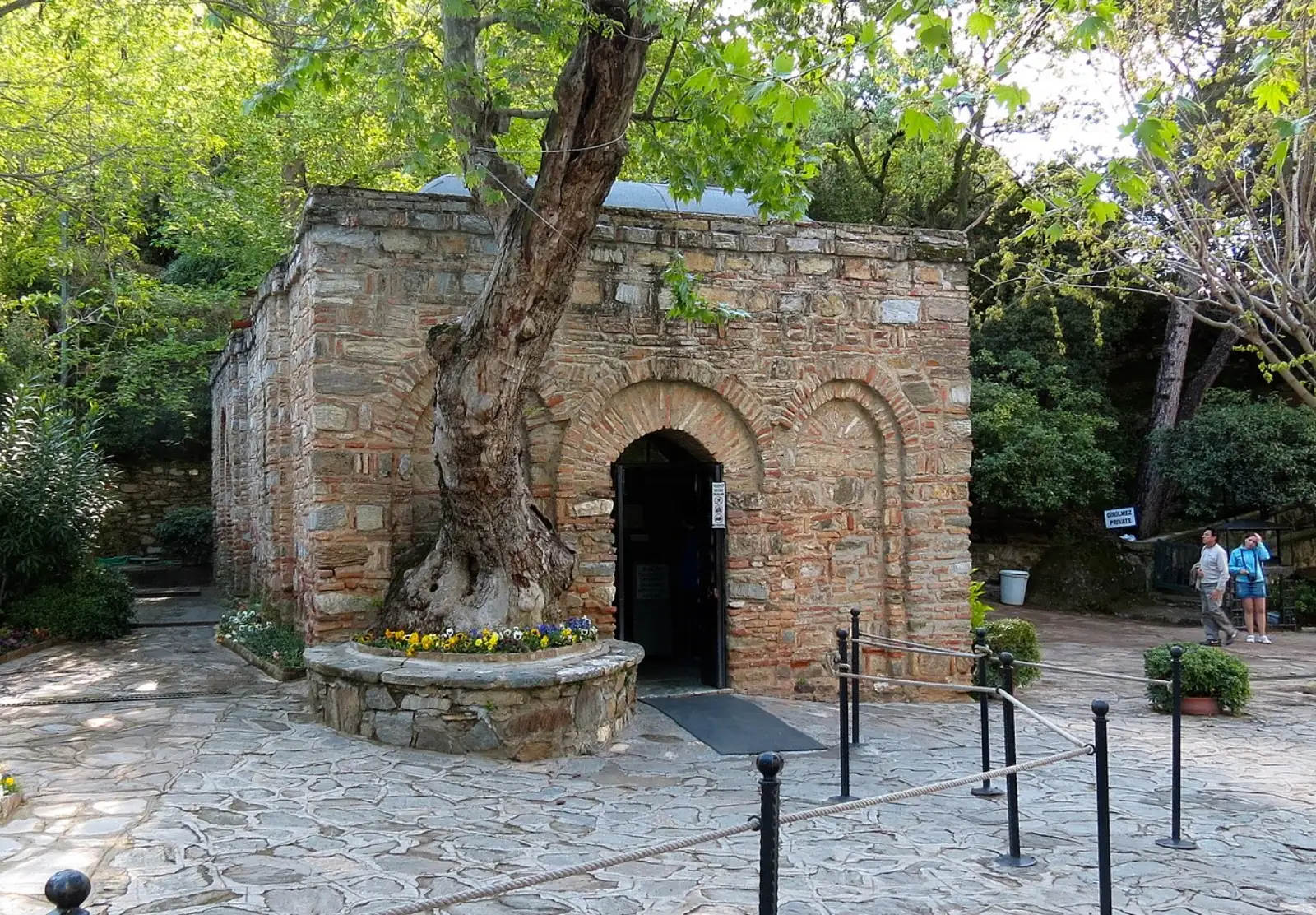
When Christianity arrived, Ephesus did not simply abandon its spiritual identity. In 431 CE, the Council of Ephesus -- held in the Church of Mary, within the ancient city -- proclaimed the Virgin Mary as "Theotokos" (God-bearer). It was here, in the city of the great Mother Goddess, that Marian veneration was formally established in Christian doctrine.
The transition from Mother Goddess to Mother of God is unique to Ephesus, and it gives the Temple of Artemis site a deeper resonance than its solitary column might suggest.
Is the Temple of Artemis Worth Visiting?
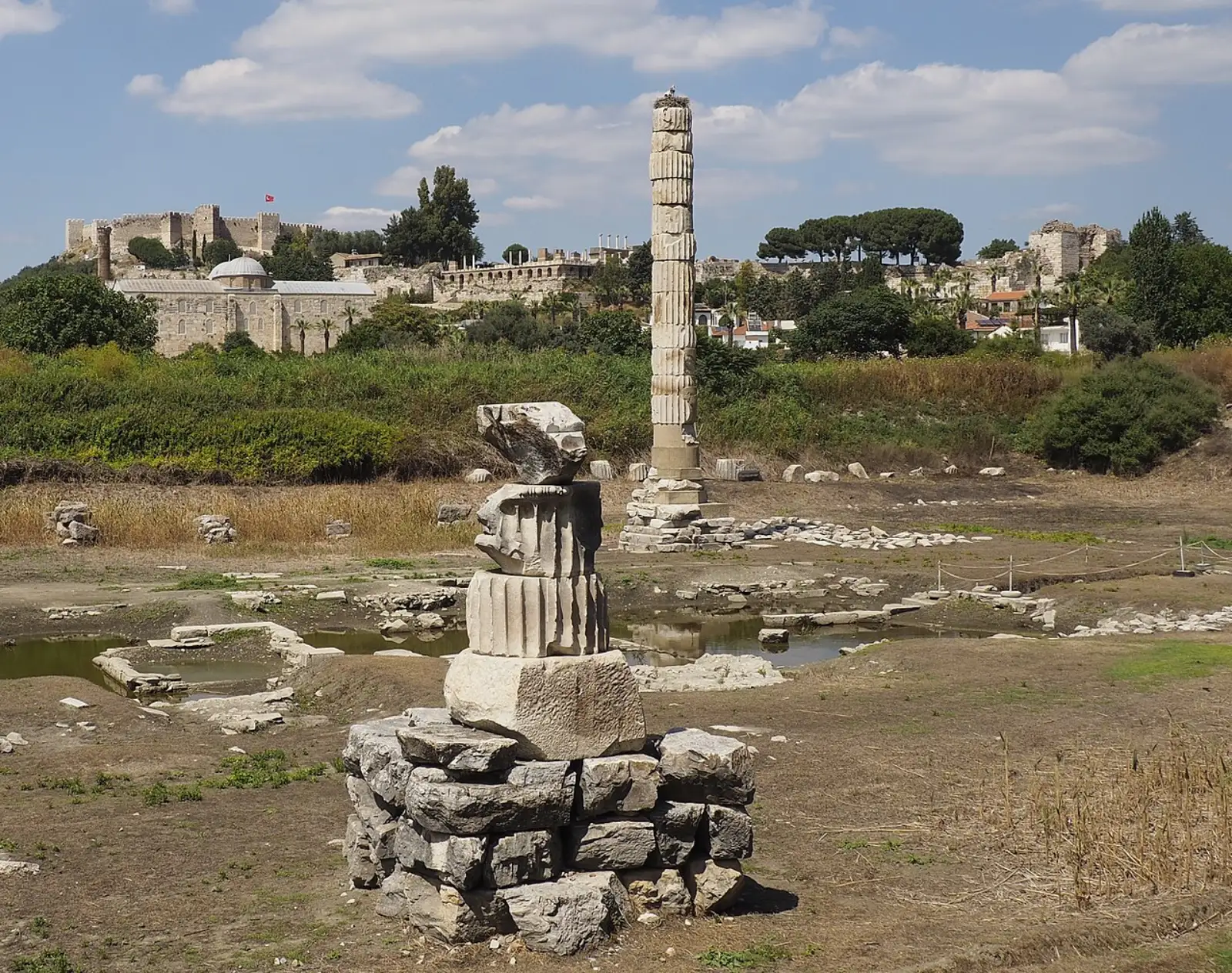
Visitor reviews are sharply mixed. If you expect a grand ruin, you will be disappointed. What remains today is a foundation, a marshy field, and a single reconstructed column -- sometimes with a stork nesting on top.
But if you come with an understanding of what stood here -- one of the largest and most celebrated buildings in the ancient world, a Wonder that drew pilgrims for a thousand years -- the experience changes. The emptiness itself becomes part of the story. This is what two and a half millennia of fire, invasion, earthquakes, and quarrying do to even the greatest monuments.
Practical details: The Temple of Artemis site is located about 2 km from the main Ephesus archaeological site, near the town of Selcuk. Admission is free. Allow 15-30 minutes. It pairs well with a visit to the nearby Basilica of St. John and Isa Bey Mosque on Ayasuluk Hill.
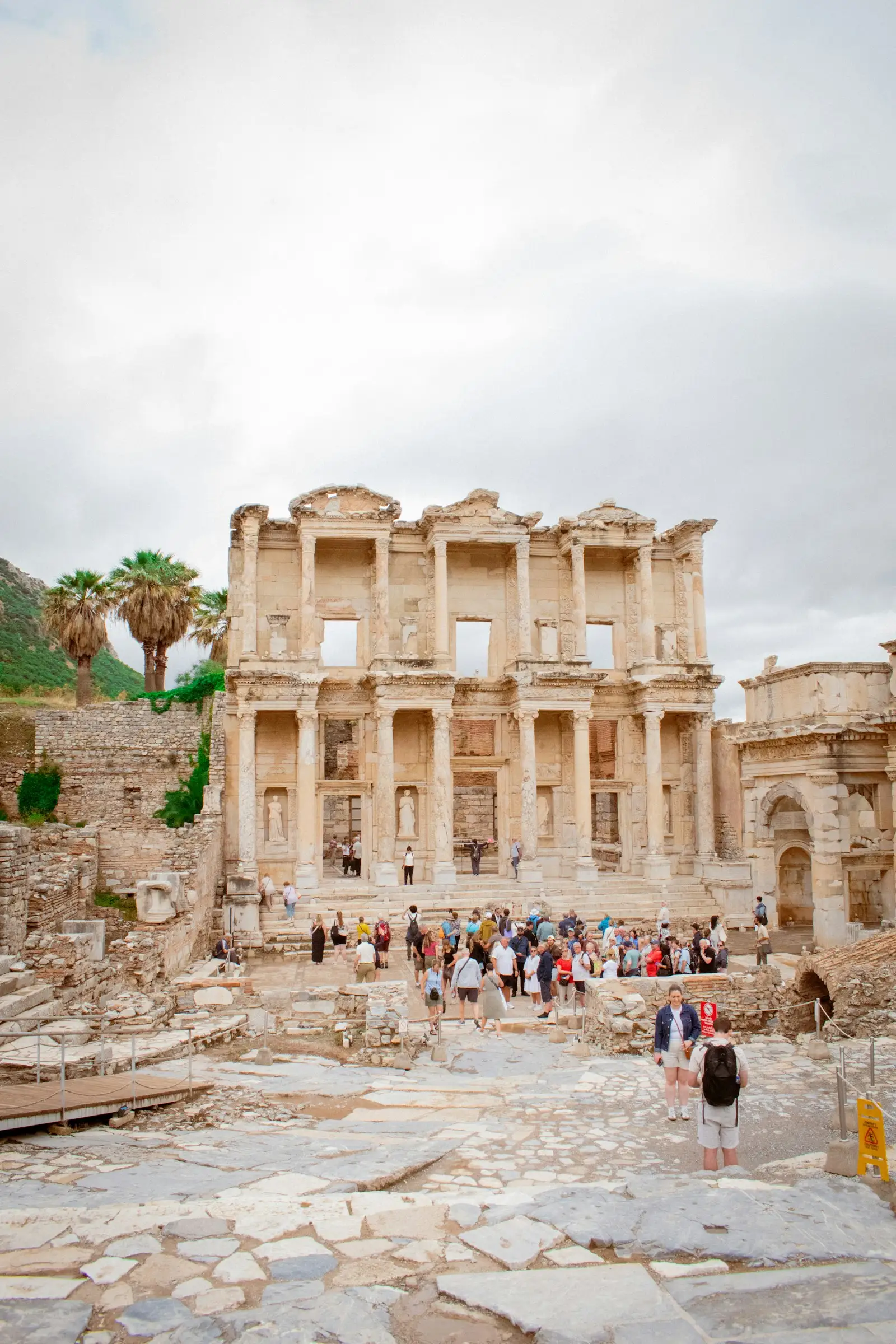
The main Ephesus archaeological site -- where the Library of Celsus, Great Theatre, and Terrace Houses await -- is the centerpiece of any visit to the region. Book your Ephesus tickets in advance to skip the queue and secure your preferred date.