COMPLETE GUIDE
The Complete Guide to Ephesus
Everything you need to know about visiting one of the ancient world's greatest cities — from tickets and transport to 3,000 years of history.
Last updated:
Ephesus is the best-preserved Greco-Roman city in the Mediterranean. Designated a UNESCO World Heritage Site in 2015, it is a place where marble streets, monumental facades, and ancient houses survive in extraordinary detail. Once the capital of Roman Asia under Emperor Augustus and home to the Temple of Artemis — one of the Seven Wonders of the Ancient World — it later became a crucible of early Christianity. This guide covers everything you need to plan your visit: what to see, how to get there, tickets, timing, and the stories behind the stones.
2.63M
Visitors in 2024
3,000+
Years of history
2015
UNESCO inscription
10–15%
Excavated so far
WHY VISIT
Why Visit Ephesus?
One of the ancient world's greatest cities, preserved in extraordinary detail.
Ephesus is one of the most complete ancient cities in the world. Inscribed as a UNESCO World Heritage Site in 2015 under three criteria (iii, iv, vi), it is recognized by UNESCO as one of the most complete Greco-Roman urban landscapes anywhere. As the capital of the Roman province of Asia under Emperor Augustus, Ephesus was the administrative and commercial heart of the eastern Mediterranean — described as the third or fourth largest city in the Roman Empire, after Rome, Alexandria, and Antioch. According to Turkish media reports citing official figures, approximately 2.63 million visitors walked its marble streets in 2024 — a record that speaks to the site's enduring power.
What makes Ephesus exceptional is the sheer density of what survives. A 25,000-seat theatre, a reconstructed library facade rising 17 meters, luxury houses with intact mosaics and frescoes, monumental fountains, temples, and an elaborate marble-paved avenue — all within a walkable site. And this is only the beginning. The Austrian Archaeological Institute, which has led excavations since 1895, estimates that only 10–15% of the ancient city has been uncovered. The 'Endless Ephesus' project is actively developing new tour routes through recently excavated sections.
Ephesus also stands at a unique crossroads of faith. The city transitioned from pagan mother-goddess worship — centered on the Temple of Artemis, one of the Seven Wonders of the Ancient World — to becoming a crucible of early Christianity. The Apostle Paul preached here for over two years (c. 52–55 CE), and in 431 CE the Council of Ephesus proclaimed Mary as Theotokos (God-bearer), permanently shaping Christian theology and Marian veneration. Few places on earth weave together ancient urbanism, monumental architecture, and religious history so powerfully.
Ready to experience it for yourself? Book your Ephesus tickets and start planning your visit.
HISTORY
A Brief History
3,000 years from Ionian founding to UNESCO World Heritage.
Founding (c. 1000 BCE)
Androclus, son of Codrus, refounded the city around 1000 BCE as part of the Ionian migration from mainland Greece. Habitation near the site dates to the Neolithic Age, with Carians and Lelegians among the earliest inhabitants.
Temple of Artemis (c. 550 BCE)
Lydian King Croesus funded construction of the Temple of Artemis, which became one of the Seven Wonders of the Ancient World. In 356 BCE, Herostratus deliberately burned the temple seeking eternal fame — according to tradition, on the same night Alexander the Great was born.
Alexander the Great (334 BCE)
Alexander liberated Ephesus from Persian rule and offered to fund the reconstruction of the Temple of Artemis. The Ephesians diplomatically declined: 'It was not seemly for one god to build a temple to another.'
Lysimachus Relocates the City (c. 286 BCE)
Alexander's successor Lysimachus relocated the city to its present site between Mount Pion and Mount Coressus. When citizens resisted, he allegedly blocked the sewage system during storms to force their migration to the new location.
Roman Capital (27 BCE onward)
Ephesus reached its peak as the capital of Roman Asia. Under Emperor Augustus, it became the administrative and commercial heart of the eastern Mediterranean and entered its period of greatest construction. The Library of Celsus, Great Theatre expansion, Temple of Hadrian, and Fountain of Trajan all date to this golden age.
Early Christianity (52–431 CE)
The Apostle Paul spent over two years preaching in Ephesus (c. 52–55 CE), provoking the famous silversmiths' riot in the Great Theatre. Ephesus was one of the Seven Churches of Asia in the Book of Revelation. In 431 CE, the Council of Ephesus proclaimed Mary as Theotokos (God-bearer), permanently shaping Christian theology.
Decline & Rediscovery (5th century–present)
The harbor progressively silted up, moving the coastline an estimated 5–6 km from the city and driving Ephesus into decline. The city was reportedly abandoned by the 15th century. The Austrian Archaeological Institute began systematic excavations in 1895 and meticulously reconstructed the Library of Celsus facade between 1970 and 1978. UNESCO inscribed Ephesus as a World Heritage Site in 2015.
LANDMARKS
What to See
The must-visit monuments along the marble streets of Ephesus.

Library of Celsus
110s CEApproximately 12,000 scrolls • 17m facade
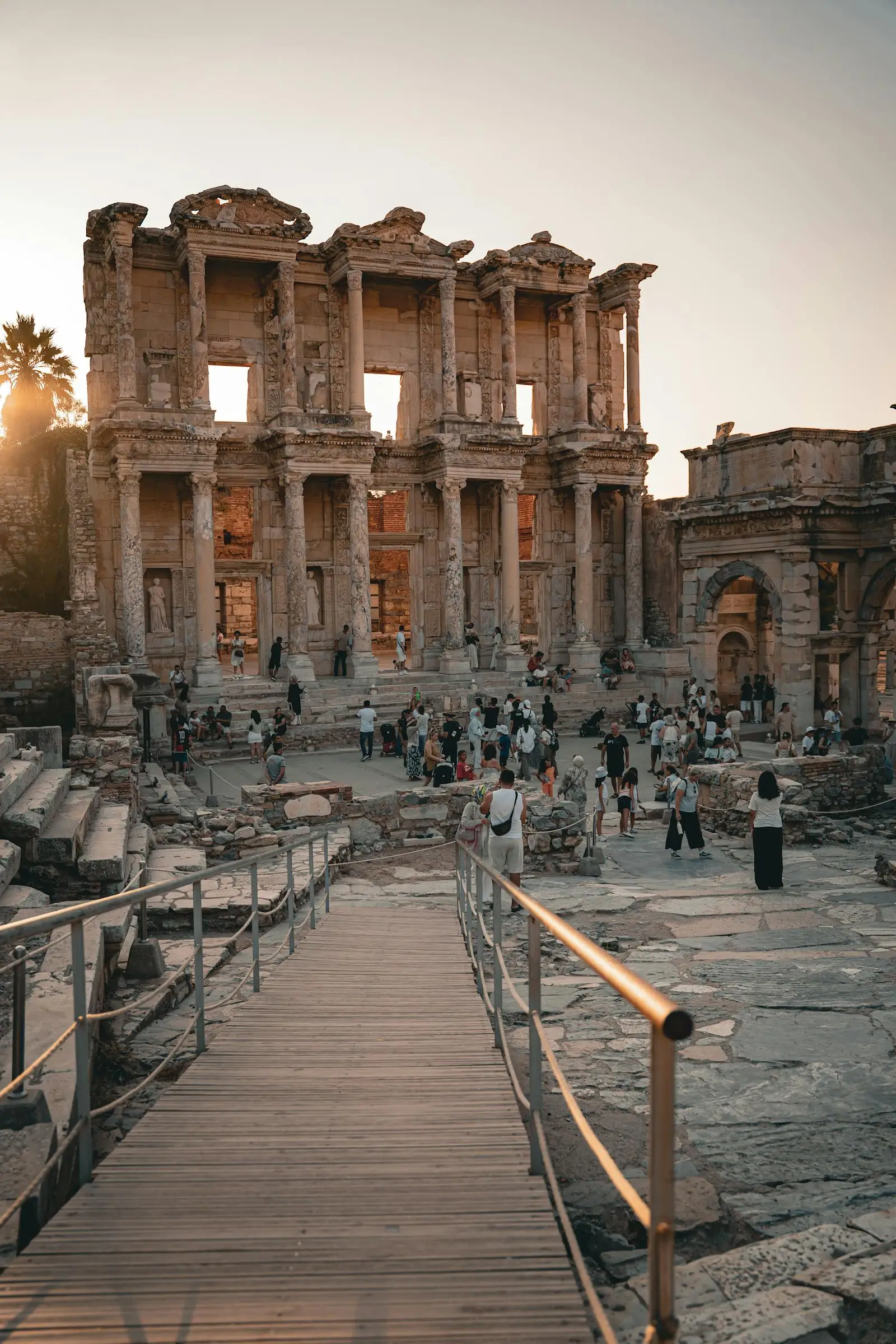
The Library of Celsus is the iconic symbol of Ephesus. Built in the 110s CE as a funerary monument by Tiberius Julius Aquila for his father, it was approximately the third-largest library in the Greco-Roman world, behind Alexandria and Pergamum, holding an estimated 12,000 scrolls. The facade, reconstructed by Austrian archaeologists between 1970 and 1978, rises 17 meters and features four Virtues statues: Sophia, Arete, Ennoia, and Episteme. The east-facing facade is best photographed in morning light.
Celsus is buried in a marble sarcophagus directly beneath the library — an exceptional honor, as Roman law normally forbade burial within city limits.

Great Theatre
1st century BCE – 2nd century CE24,000–25,000 seats
The Great Theatre is the largest ancient theatre in Asia Minor, seating 24,000 to 25,000 spectators. Built into Mount Pion and used for drama, political assemblies, and gladiatorial combats, it is where the biblical silversmiths' riot against the Apostle Paul took place (Acts 19), with craftsmen chanting 'Great is Artemis of the Ephesians!' for two hours.
The theatre's interior seating area has been closed since April 2025 for restoration as part of the 'Endless Ephesus: Heritage for the Future' project. Visitors can view it from the exterior via the Commercial Agora. No reopening date has been announced.

Temple of Hadrian
117–138 CETyche & Medusa reliefs
An ornate Corinthian temple on Curetes Street featuring a beautifully carved arch with a relief bust of Tyche (goddess of fortune) in the center and a Medusa above the inner doorway. The visible decorative panels are copies — the originals are preserved in the museum.

Terrace Houses
1st century BCE – 7th century CEEUR 15 add-on • Shaded
The Terrace Houses are the best-preserved Roman domestic interiors at Ephesus. These six luxury residential units housed the wealthy elite, with some reaching approximately 900 square meters. They contain exquisite floor mosaics, wall frescoes, sophisticated hypocaust underfloor heating, and ancient wall graffiti including gladiator drawings and love poems. Glass walkways allow visitors to view archaeological layers underfoot. One of the few shaded areas at Ephesus.
Curetes Street
Roman210m marble avenue
Curetes Street is the main processional avenue of ancient Ephesus. This marble-paved road stretches 210 meters from Hercules Gate to the Library of Celsus, lined with the Temple of Hadrian, Fountain of Trajan, Scholastica Baths, and the entrance to the Terrace Houses. A sophisticated sewage system runs beneath the marble.
The ancient marble surface is polished dangerously smooth by millions of feet — walk slowly and wear non-slip shoes.
Harbour Street
Roman530m colonnaded
Harbour Street is a grand 530-meter colonnaded avenue connecting the Great Theatre to the ancient port. It features an 11-meter-wide central roadway with porticos on both sides, mosaic-paved floors, shops, and an underground sewage system.
Fountain of Trajan
114 CE17m monumental facade
The Fountain of Trajan is one of the largest monumental fountains at Ephesus. Its facade stretches 17 meters long, surrounding a water basin originally dominated by a colossal statue of Emperor Trajan standing approximately 4 meters tall — only the foot survives today. The facade featured approximately ten statues in niches, believed to include Aphrodite, Dionysus, and a reclining satyr.
Public Latrines
Roman48 marble seats
The Public Latrines offer a fascinating glimpse into Roman daily life. This communal facility features 48 marble toilet seats flushed by continuously flowing water recycled from the nearby baths. The latrines were a social space where Romans reportedly conducted business while using the facilities. It is believed that Romans used sponges on sticks (tersorium), stored in vinegar, rather than paper.
PLAN
Plan Your Visit
Tailored advice for every type of visitor.
Cruise Passenger
Arriving from Kusadasi? The port is just 19 km away — a 20–30 minute taxi ride. With a typical 5–10 hour port call, you have plenty of time to explore the highlights and even add the Terrace Houses. Get off the ship early to beat the tour bus crowds.
Read the Cruise Passengers' Guide →Day-Tripper from Izmir
Take the TCDD train from Izmir Basmane to Selcuk (approximately 1.5 hours, approximately EUR 2.50–3). There are 8–9 daily departures. From Selcuk, a short dolmus or taxi ride reaches the gates. It is an easy, affordable day trip with time to spare for lunch and the Archaeological Museum.
Plan Your Visit →History Enthusiast
From the Temple of Artemis — one of the Seven Wonders of the Ancient World — to Paul's explosive ministry and the council that defined Christian theology, Ephesus spans 3,000 years of layered history. Dive into the full timeline, from Ionian founding myth to modern excavation.
Explore the Full History →First-Time Visitor
Start at the Upper Gate and walk downhill to the Lower Gate — a 1.5–2.4 km route that passes every major monument. Arrive at the 08:00 opening for the smallest crowds, add the Terrace Houses for their shaded mosaics and frescoes, and allow 2–3 hours for a standard visit or 3–5 hours if you want to see everything.
Read the Practical Guide →Quick Reference
Ticket Price
Terrace Houses Add-on
EUR 15
Combo Ticket
EUR 52 (standard + Terrace Houses — saves EUR 3)
Summer Hours
08:00 – 19:00 (Apr–Sep)
Winter Hours
08:00 – 18:00 (Oct–Mar)
Gate Strategy
Enter Upper Gate, walk downhill to Lower Gate (~1.5–2.4 km)
Visit Duration
2–3 hours standard, 3–5 hours with Terrace Houses
For detailed practical tips, see our practical visitor guide.
DEEP DIVES
Go Deeper
Explore our detailed guides on visiting, history, and cruise logistics.
Visiting Ephesus
Tickets, opening hours, what to bring, accessibility, two-gate strategy, and practical tips for making the most of your visit.
History of Ephesus
From its founding around 1000 BCE through the Roman golden age to UNESCO World Heritage status — 3,000 years of history brought to life.
Cruise Passengers' Guide
Port logistics, transport options from Kusadasi, timing advice, and a suggested itinerary for making the most of your port call.
NEARBY
Beyond the Ruins
More to see within easy reach of the archaeological site.
Basilica of St. John
The Basilica of St. John is believed to mark the burial site of St. John the Apostle. Built by Emperor Justinian I (approximately 548–565 CE) on Ayasuluk Hill, it was reportedly one of the largest churches ever built in Asia Minor, second only to Hagia Sophia. Highlights include the rebuilt tomb, frescoes, and panoramic views from the upper terrace.
Isa Bey Mosque
A beautiful 1375 Seljuk mosque built using marble recycled from the Temple of Artemis. One of the finest surviving examples of Anatolian Seljuk architecture. Cover shoulders and knees when visiting.

Temple of Artemis
The Temple of Artemis was one of the Seven Wonders of the Ancient World. The original temple, funded by Lydian King Croesus around 550 BCE, was roughly four times the floor area of the Parthenon with 127 columns standing 18.3 meters high. Today only foundations and a single reconstructed column remain in a marshy field. Worth a stop if passing by, but bring your imagination.

Ephesus Archaeological Museum
The Ephesus Archaeological Museum in Selcuk houses thousands of artifacts excavated from the site. Highlights include the famous 'Great Artemis' and 'Beautiful Artemis' statues with distinctive egg-shaped fertility symbols, original friezes from the Temple of Hadrian, and imperial busts. A 10-minute 3D simulation recreates ancient Ephesus. Air-conditioned — a welcome break on hot days.

House of the Virgin Mary
The House of the Virgin Mary is a Vatican-recognized pilgrimage site where tradition holds Mary spent her final years. Located 7 km from Ephesus on a wooded hillside, it has been visited by three popes. The site is sacred to both Christians and Muslims — Mary is mentioned 34 times by name in the Quran. Sunday Mass at 10:30 AM in English. Modest dress required.

Sirince Village
Known as the 'Tuscany of Turkey,' this former Greek hillside village 8 km east of Selcuk is famous for its fruit wine tasting — dozens of wine houses offer free samples of black mulberry, peach, cherry, and pomegranate wines. Features well-preserved Ottoman-Greek architecture, artisan markets, and excellent home-style food. A great lunch destination.
Cave of the Seven Sleepers
A legendary cave 2 km from the ruins where, according to both Christian and Islamic tradition, seven young Christians hid from Roman persecution and fell into a miraculous sleep lasting approximately 200 years. The story appears in the Quran (Surah 18), making the site sacred to Muslims as well.
FUN FACTS
Did You Know?
Celsus is buried in a marble sarcophagus beneath his library — an exceptional honor, as Roman law normally forbade burial within city limits.
When citizens resisted relocating, Lysimachus allegedly blocked the sewage system during storms to force their migration to the new site.
A gladiator graveyard reportedly discovered in 1993 revealed skeletons with distinctive combat injuries, including what appeared to be trident wounds.
It is believed that Romans used communal sponges on sticks, stored in vinegar, in the public latrines — sometimes cited as the origin of the phrase 'getting the wrong end of the stick.'
When Alexander the Great offered to rebuild the burned Temple of Artemis, the Ephesians diplomatically declined: 'It was not seemly for one god to build a temple to another.'
Ephesus is home to numerous stray cats, beloved by visitors and frequently photographed lounging among ancient ruins that are nearly 2,000 years old.
FAQ
Frequently Asked Questions
The most common questions from visitors planning a trip to Ephesus.
For full visitor details, see our practical guide. Ready to book? Get your tickets. Have more questions? Browse the complete FAQ.