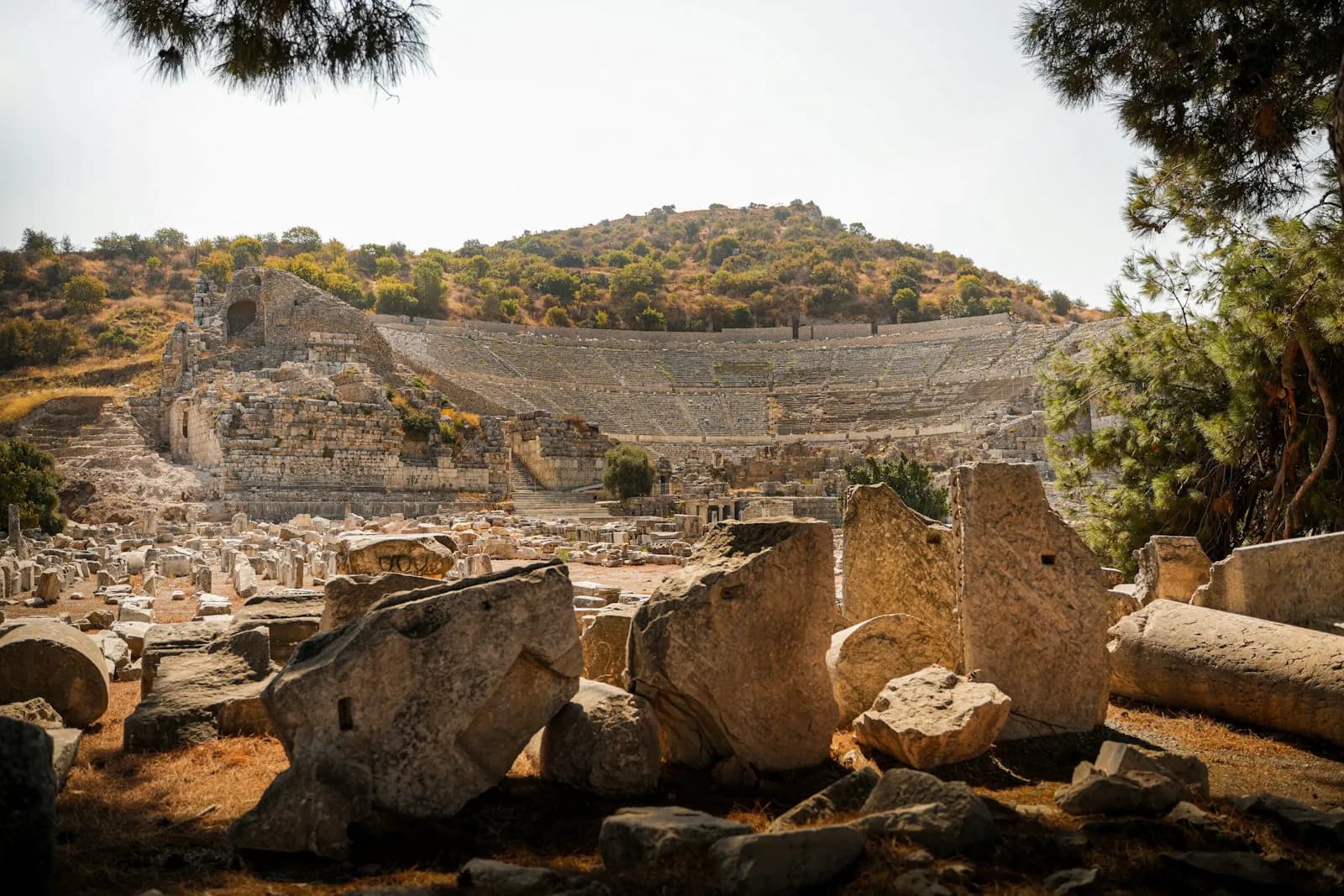
The Great Theatre of Ephesus is the largest ancient theatre in Asia Minor, with 24,000-25,000 seats carved into the slope of Mount Pion. It hosted everything from Greek drama to gladiatorial combat to a biblical riot -- and it still serves as a performance venue today. The interior seating area is currently closed for restoration, with no reopening date announced.
How Big Is the Great Theatre?
The numbers are staggering. The theatre spans 145 meters wide and rises approximately 30 meters high, with 66 rows of marble seats arranged in three tiers. At full capacity, it held 24,000-25,000 spectators -- enough to seat a significant fraction of the city's population.
To put that in perspective, it is larger than most modern concert venues. Madison Square Garden holds about 20,000.
The lower rows near the stage featured marble seats with back supports, reserved for prominent citizens and officials. The higher you climbed, the lower your social status. But even from the top row, the acoustics were exceptional -- a testament to Hellenistic engineering that modern architects still study.
When Was It Built?
The theatre's history spans several centuries of construction and expansion. The original structure dates to the Hellenistic period, when Greek architects carved the seating into the natural hillside. But the theatre you see today is primarily Roman.
Major enlargements took place under Emperors Claudius and Nero in the 1st century CE. The project was completed under Emperor Trajan in the early 2nd century CE, reaching the massive scale visible today. Each phase of construction expanded the seating, enhanced the stage building, and added architectural refinements.
The Silversmiths' Riot
The theatre's most famous moment is recorded in the Bible. Around 57 CE, the Apostle Paul had been preaching Christianity in Ephesus for over two years, and his message was gaining traction. This alarmed Demetrius, a silversmith who made miniature shrines of Artemis -- a lucrative trade threatened by Paul's monotheistic teachings.
Demetrius rallied his fellow craftsmen. The crowd swelled and surged into the Great Theatre, dragging two of Paul's companions with them. For two hours, the mob chanted a single phrase: "Great is Artemis of the Ephesians!"
The account in Acts 19 describes the scene vividly -- a packed theatre, a furious crowd, confused bystanders who did not even know why they were there. The city clerk eventually calmed the crowd by reminding them that the courts existed for legal grievances and that the riot risked Roman reprisal.
The silversmiths' riot captures a pivotal moment in history: the collision between the old pagan world and the new Christian faith, playing out in real time before 25,000 witnesses.
Not Just Drama: Gladiators in Ephesus
While the theatre was built for performances and public assemblies, the Romans adapted it for a very different purpose: gladiatorial combat. Evidence from inscriptions and archaeological finds confirms that gladiatorial games took place here alongside the traditional dramatic performances.
The most dramatic proof came from a gladiator graveyard discovered nearby in 1993. Forensic analysis of the skeletons revealed distinctive combat injuries -- including wounds consistent with trident strikes, the signature weapon of the retiarius class of gladiator. A 2007 BBC documentary brought this discovery to wider public attention, sparking renewed interest in Roman combat culture at Ephesus.
The graveyard humanized what had been abstract history. These were real people -- young men, mostly in their twenties, whose bones told stories of violent careers and violent ends.
VIP Seating and Social Order
The theatre's seating was not democratic. The lower rows, closest to the stage, featured individual marble seats with carved back supports -- a comfort reserved for magistrates, priests, and wealthy benefactors. Inscriptions on some seats identify them as belonging to specific guilds or officials.
The middle tiers accommodated ordinary citizens, while the upper rows -- steepest and farthest from the action -- were for the lowest social classes. The theatre was, in effect, a map of Roman social hierarchy carved in stone.
The Opera Festival: Ancient Stage, Modern Performances
Despite its age, the Great Theatre remains a working venue. The International Ephesus Opera and Ballet Festival stages performances here, using the ancient acoustics and the dramatic hillside setting to create an experience no modern concert hall can replicate.
Performances continue even during the current restoration period. If your visit coincides with the festival, it is an extraordinary way to experience the space as it was meant to be used -- filled with voices, music, and an audience of thousands.
Current Restoration Status
The Great Theatre's interior seating area has been closed to visitors since April 2025 as part of the "Endless Ephesus: Heritage for the Future" restoration project. Visitors can view the theatre from the exterior via the Commercial Agora but cannot enter the seating tiers or reach stage level.
No reopening date has been announced. Ground-penetrating radar has revealed approximately 2,000 additional unexcavated seats, suggesting the theatre may have been even larger than previously understood.
The restoration project also includes a new visitor route along Stadium Street, connecting the Theatre to Harbor Street via newly excavated areas -- promising fresh discoveries when the work is complete.
Visiting the Great Theatre Today
Even from the exterior, the theatre is impressive. The sheer scale of the structure -- visible from across the site as you walk down Harbor Street -- gives you an immediate sense of Ephesus as a major metropolis, not a quaint ruin.
What you can see now: The full exterior facade from the Commercial Agora, including the three tiers of seating and the remains of the stage building. The view from Harbor Street (the ancient Arcadian Way) gives the best sense of scale.
Photography tip: Late afternoon light warms the stone beautifully. A wide-angle lens from Harbor Street captures the full sweep of the theatre against the hillside.
The Great Theatre is part of the main Ephesus archaeological site. Entry is included in the standard EUR 40 ticket -- no separate admission required.