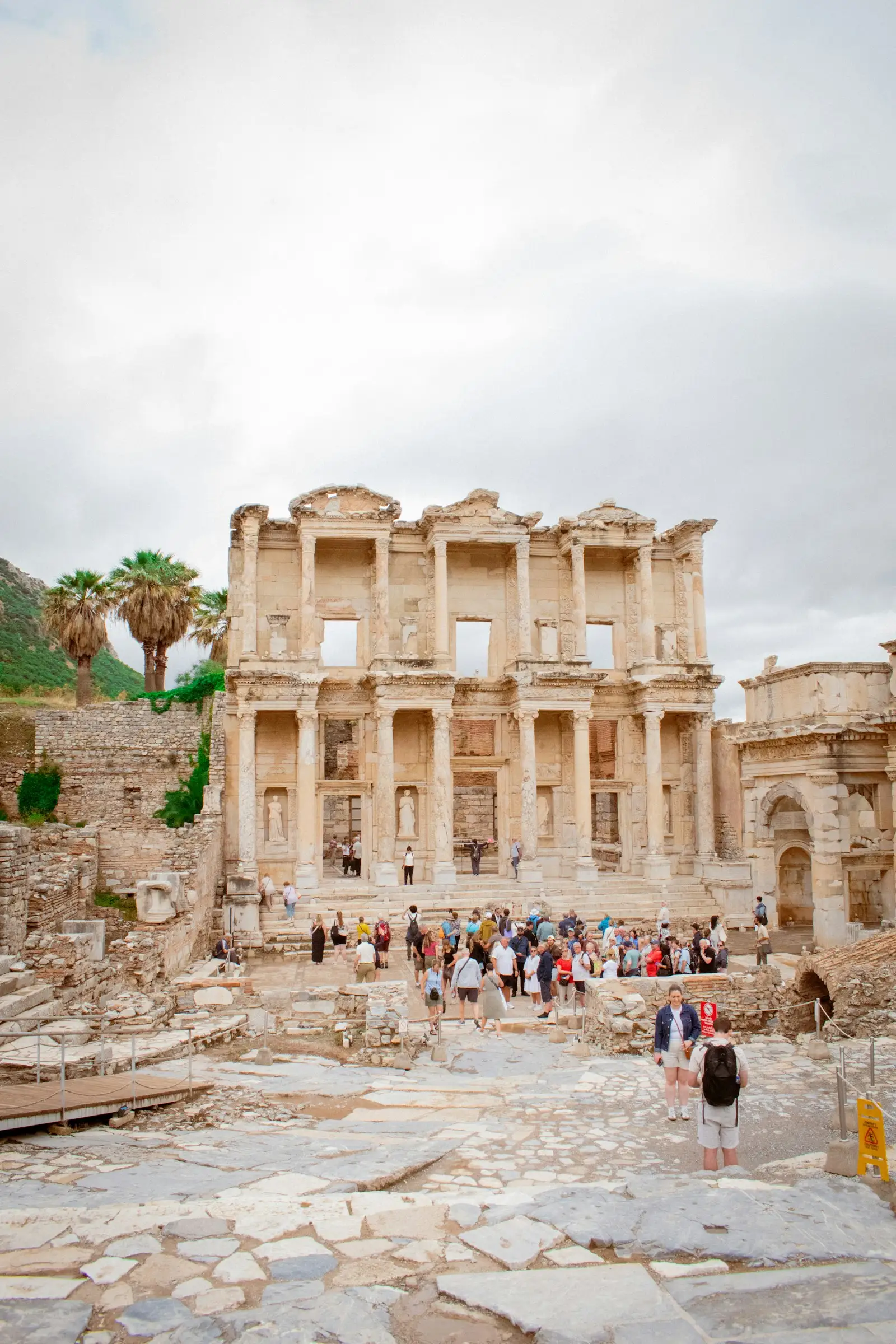
The Library of Celsus is the most photographed monument in Turkey outside of Istanbul. Built in the 110s CE as both a library and an illegal tomb, its reconstructed facade rises 17 meters above the ancient street -- a masterclass in Greek optical illusion that held approximately 12,000 scrolls.
Who Built the Library of Celsus?
The library was built in the 110s CE by Tiberius Julius Aquila to honor his father, Tiberius Julius Celsus Polemaeanus, a Roman senator and former proconsul (governor) of the province of Asia. It was both a grand public library and a deeply personal monument -- a son's tribute to an accomplished father.
What made it extraordinary was what lay beneath. According to archaeological records, Celsus himself is buried in a marble sarcophagus under the library's foundation. Roman law normally forbade burial within city limits. That this exception was granted tells you everything about the family's status in Ephesus.
How Big Was the Library?
Historical records indicate the library held approximately 12,000 scrolls, making it the third-largest in the Greco-Roman world behind only Alexandria and Pergamum.
The reading room occupied the ground floor, with niches in the walls designed to store the scrolls and allow air circulation to protect them from moisture.
The two-story facade rises 17 meters and faces east. That orientation was deliberate -- the morning sun flooded the reading room with natural light, giving scholars the best conditions for their work.
The False Perspective Trick
The facade uses a Greek architectural technique called false perspective to appear larger and more imposing than it actually is.
Look carefully at the columns. They are not all the same height. The central columns are slightly shorter than the outer ones, and the upper story's proportions are subtly adjusted.
The effect is remarkable. Standing at the base of the steps, the library seems to tower overhead with a grandeur that photographs only partially capture. It is one of the finest surviving examples of this optical illusion in the ancient world.
The Four Virtues
Four female statues representing classical virtues stand in niches flanking the library entrance. Each represents a quality that Celsus embodied:
- Sophia (Wisdom)
- Arete (Excellence/Valor)
- Ennoia (Thought/Intellect)
- Episteme (Knowledge)
The statues you see today are copies. The originals were removed during excavation and now reside in museums -- a common preservation practice for irreplaceable ancient sculpture exposed to weather and foot traffic.
Destruction and Collapse
The library's collection was lost in 262 CE when invading Goths sacked Ephesus and burned the interior.
The reading room was destroyed, but the massive stone facade survived. It stood for another seven centuries or more as a silent monument -- until an earthquake in the 10th or 11th century finally brought the facade crashing down.
The columns, capitals, and carved reliefs lay scattered in the rubble for nearly a thousand years.
The Austrian Reconstruction
The facade was reconstructed between 1970 and 1978 by the Austrian Archaeological Institute in one of the most ambitious projects in classical archaeology.
Working from the fallen stones and detailed records, the team re-erected the facade piece by piece. The result is not a replica, but a reassembly of original materials in their original positions. It stands as one of the most successful archaeological reconstructions anywhere in the world.
The Carved Footprint on Marble Street
A carved footprint in the marble pavement near the library is one of Ephesus's most talked-about curiosities, though its true purpose remains debated.
Popular legend calls it "the oldest advertisement in history" -- supposedly pointing the way to a nearby building identified as a brothel. The reality is more nuanced. Egyptian advertisements predate this carving by roughly 3,000 years, so it is far from the oldest.
Scholars debate whether it was a directional marker, a merchant's sign, or something else entirely. Either way, it is a fragment of daily life carved into stone two millennia ago.
The Tunnel Legend
No confirmed archaeological evidence supports the famous tunnel story, though it remains a staple of tour guide narratives.
According to popular legend, an underground tunnel connects the Library of Celsus to a building across the street once identified as a brothel. The tunnel's purpose and the building's actual function have not been archaeologically confirmed. Like many Ephesus stories, the legend is part of the site's charm -- blurring the line between documented history and entertaining tradition.
Visiting the Library Today
The Library of Celsus is included in the standard Ephesus entry ticket (EUR 40) and stands along the main walking route where Curetes Street meets Marble Street. You cannot miss it.
Photography tip: The east-facing facade catches beautiful morning light. Arrive at the 08:00 opening and head straight to the Library for the best photographs with minimal crowds. By mid-morning, tour groups fill the steps and plaza.
No separate admission is required. Plan to spend 15-20 minutes here -- longer if you want to study the architectural details and photograph each of the Virtue statues.
Stand at the base of the steps and look up. The false perspective will do its work. For a moment, you will see what visitors saw nearly two thousand years ago -- a building designed to overwhelm, to honor the dead, and to celebrate the power of knowledge.